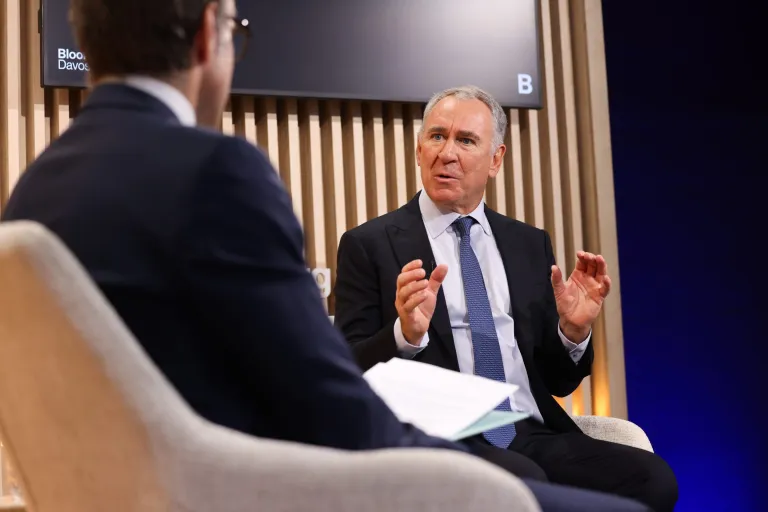
The global bond market is delivering what Citadel founder Ken Griffin describes as an unmistakable signal, and the United States should pay close attention. Speaking in Davos this week, Griffin said recent turmoil in global debt markets amounts to a bond market warning about what happens when governments fail to keep their fiscal house in order.
While much of the world’s economic focus has been on discussions at the World Economic Forum in Switzerland, Griffin pointed to developments in Japan as a more telling signal. Japan’s government bond market suffered a sharp selloff, pushing yields to historic highs. Ten year yields climbed to around 2.2 percent, while 30 year yields surged to roughly 3.66 percent, levels that underscore investor unease.
A lesson from Japan’s bond selloff
The Japanese selloff reflects a mix of geopolitical tension and concerns over Prime Minister Sanae Takaichi’s expansive stimulus agenda, which includes a roughly ¥21.3 trillion economic plan aimed at supporting a heavily indebted economy. For Griffin, the lesson is clear. When investors begin to doubt fiscal discipline, they demand higher compensation to hold government debt.
“I think there’s an explicit warning that if your fiscal house is not in order, the bond vigilantes can come out and retract their price,” Griffin said during a Bloomberg-hosted event in Davos. Griffin is the founder and chief executive of Citadel Advisors LLC, one of the world’s largest hedge fund firms, and a closely watched voice on global markets.
That bond market warning resonates in the United States, where Treasury yields have recently approached levels that unsettle investors. Ten year yields moved closer to the 5 percent mark this week, a threshold many market participants see as significant.
Why the 5 percent yield matters
The concern is not simply that yields are rising, but what those yields imply for portfolio construction. At around 5 percent, returns on government bonds begin to rival long term equity returns. Bonds traditionally play a stabilizing role, offering lower risk and acting as a hedge during stock market downturns.
“When bonds and stocks move together in price, then bonds are no longer a hedge for your equity portfolio,” Griffin said. He added that this dynamic strips bonds of one of their most valuable features, diversification, and forces investors to reassess risk across the entire financial system.
Recent volatility in US Treasuries was amplified by geopolitical headlines. President Donald Trump sparked uncertainty after suggesting new tariffs on European nations unless they supported his proposal to purchase Greenland. That announcement prompted questions about whether European investors might scale back their holdings of US government debt.
Trade tensions and foreign confidence
Those concerns were serious enough to draw a response from Treasury Secretary Scott Bessent, who said the chief executive of Deutsche Bank personally contacted him to apologize for a research note suggesting European investors could reduce exposure to Treasuries. Similar warnings came from other institutions, including UBS, where economist Paul Donovan described US fiscal deficits as the country’s “Achilles’ heel.”
Although markets later stabilized after President Trump eased his tariff stance, the episode highlighted how sensitive US funding conditions can be to foreign policy and investor sentiment. For Griffin, these short term swings reveal a deeper structural issue.
America’s growing funding challenge
US national debt now exceeds $38 trillion, and interest costs alone surpassed $270 billion in the final quarter of fiscal year 2025. Leaders across finance and policymaking have raised alarms. JPMorgan Chase CEO Jamie Dimon and Federal Reserve Chair Jerome Powell have both emphasized that the problem is less about the absolute size of the debt and more about how rapidly borrowing is growing relative to economic output.
Some argue the risk is overstated, noting that the Federal Reserve has the capacity to expand the money supply if necessary. Others counter that such measures carry inflationary consequences and risk undermining confidence in US creditworthiness.
“If US Treasuries are viewed as being at risk because the United States is not seen as creditworthy, then bonds and stocks will move together in price,” Griffin said. He warned that such a shift would push yields higher across the economy, raising mortgage rates and increasing the cost of financing federal deficits.
A warning, not yet a crisis
For now, investors appear relatively calm. Yields eased after trade tensions subsided, and long term bonds remain within the 4 to 5 percent range that has prevailed in recent years. Griffin does not believe the US is on the brink of a crisis, but he cautions against complacency.
“The US has so much wealth, we can maintain this level of deficit spending for some period of time,” he said. “But the longer we wait to change direction, the more draconian the consequences will be of that change.”
In Griffin’s view, the bond market warning is clear. The question is whether policymakers act before markets force their hand.